Microsoft, Apple and Amazon Web Services experienced major technology disruptions within a single week. Here’s what these incidents reveal about business continuity, cybersecurity and why reliable IT support matters for New Zealand businesses.
Technology disruptions are no longer just an IT department’s concern. They can affect customer communications, employee productivity, financial transactions and the ability to operate.
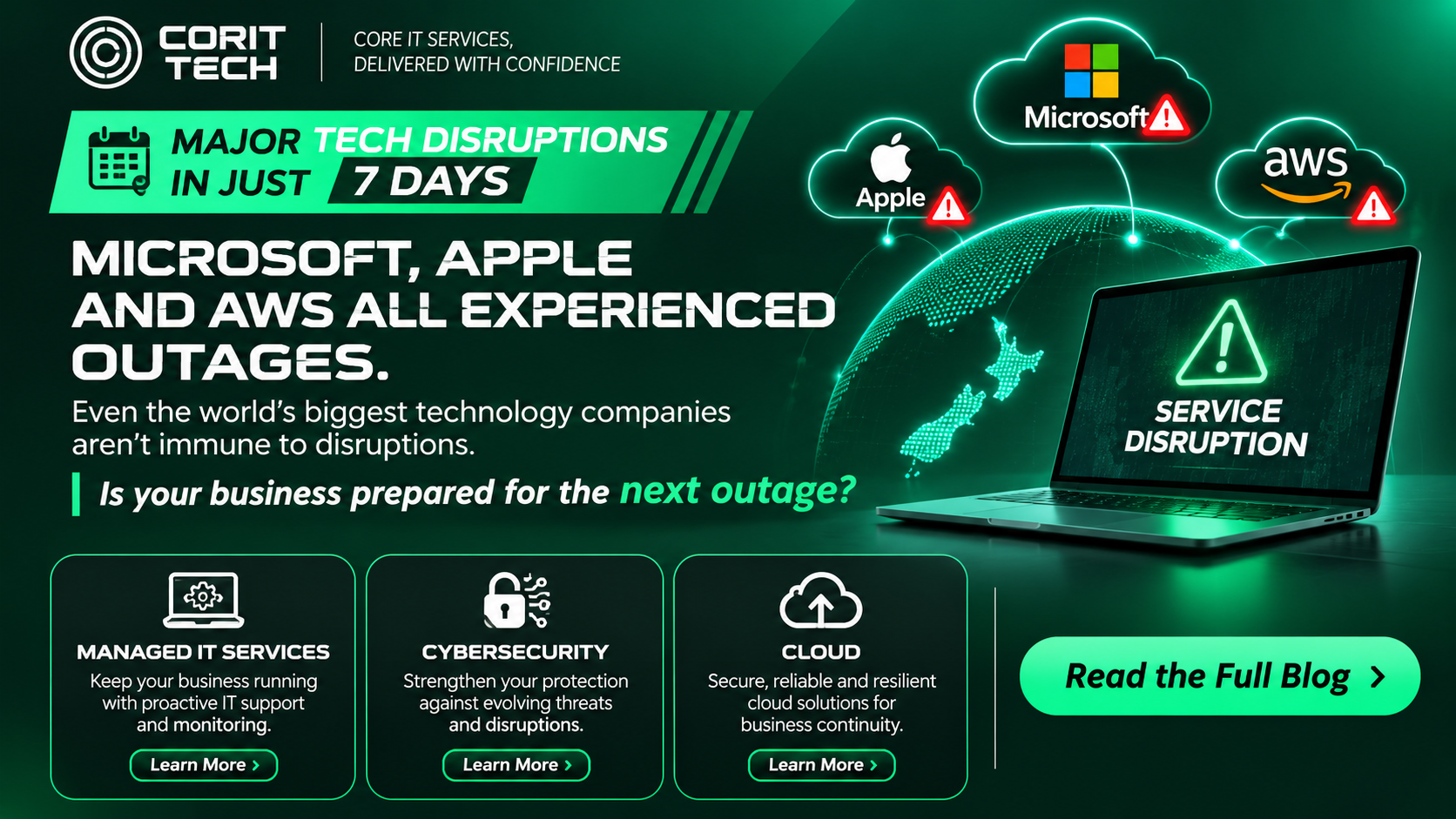
Between 12 and 17 November 2026, some of the world’s largest technology providers experienced significant service interruptions.
Microsoft 365 suffered a widespread outage. Amazon Web Services (AWS) reported authentication and connectivity issues. Apple experienced disruptions affecting services including iCloud and Apple Pay.
These incidents occurred within days of each other, raising an important question for New Zealand small and medium-sized enterprises (SMEs):
If the world’s largest technology companies can experience unexpected outages, how prepared is your business?
While these incidents were not established as cyberattacks, they highlight a broader concern: businesses need effective IT risk management, cybersecurity protection and business continuity planning to remain resilient.
MANAGED IT | CYBERSECURITY | CLOUD
Technology Disruptions Happen.
Is Your Business Prepared?
Even the world’s largest technology providers experience outages. Your business deserves a trusted IT partner who can help you prepare, respond, and recover with confidence.
CORIT Tech helps New Zealand businesses strengthen IT reliability, cybersecurity, and operational resilience.
Talk to Our IT Experts →Practical. Secure. Reliable IT Support.
What Happened? Major Technology Outages in November 2026
Microsoft 365 Outage: 12–13 November
Microsoft experienced a widespread disruption affecting Microsoft 365 services, particularly Exchange Online and Outlook.
According to Microsoft’s preliminary incident report, the outage began on 12 November and continued into 13 November, affecting email access and delivery alongside features of connected Microsoft 365 applications.
For businesses relying on Microsoft 365, such interruptions can prevent employees from accessing critical communications and completing everyday tasks.
The incident demonstrates the operational risks of depending on a single technology ecosystem without alternative communication arrangements.
AWS Service Disruption: 15 November
Amazon Web Services reported authentication and connectivity issues in its US-East-1 region on 15 November.
The disruption affected AWS IAM Identity Center and services dependent on its authentication infrastructure.
Although AWS resolved the incident, it highlighted how failures within cloud infrastructure can affect multiple connected services.
For SMEs using cloud-hosted applications, this reinforces the importance of understanding third-party technology dependencies and establishing appropriate recovery procedures.
Apple iCloud and Apple Pay Disruption: 17 November
Apple experienced service interruptions affecting iCloud, Apple Pay and other services on 17 November.
Apple attributed the incident to an internal software update and confirmed it was not a cyberattack.
The disruption followed several other technology incidents affecting major organisations during the same week.
Together, these events illustrate an important reality: even established technology providers with extensive infrastructure and technical expertise can experience unexpected service failures.
Are Technology Outages and Cybersecurity Threats Becoming More Frequent?
The number of high-profile disruptions occurring within a short period naturally raises concerns about technology reliability.
However, several incidents within one week do not necessarily establish that outages are becoming more frequent.
What is clear is that modern businesses are increasingly dependent on interconnected digital services.
Cloud computing, Microsoft 365, online payment platforms, remote collaboration tools and third-party applications have become essential to everyday business operations.
As these dependencies grow, a disruption to one service can affect multiple business functions.
Meanwhile, cybersecurity threats such as ransomware, phishing, compromised accounts and malicious network activity create additional operational risks.
Not every technology outage is a cyberattack, but both cybersecurity incidents and infrastructure failures can interrupt business operations.
That is why businesses need a broader approach to IT security and operational resilience.
Why Are Small Businesses More Vulnerable to Technology Disruptions?
Small businesses often rely on the same technology platforms as large enterprises but operate with fewer internal IT resources.
A large organisation may have dedicated cybersecurity specialists, incident response teams and established business continuity procedures.
A smaller business may depend on one employee, an external technician or an IT provider contacted only when something goes wrong.
This creates several potential vulnerabilities.
1. Limited IT Resources
Without dedicated IT expertise, identifying the cause of a disruption and coordinating an appropriate response can take longer.
2. Dependence on Cloud Services
Many businesses rely heavily on Microsoft 365, cloud applications and third-party platforms without fully understanding their operational dependencies.
3. Inadequate Backup and Recovery Planning
Storing information in the cloud does not automatically guarantee that every file, configuration or business system can be restored when needed.
4. Lack of Business Continuity Procedures
When essential services become unavailable, employees may not know how to communicate, access critical information or continue priority operations.
5. Reactive IT Support
Businesses relying solely on break-fix IT support may lack the monitoring, documentation and preparedness needed to manage unexpected incidents efficiently.
These challenges can turn a temporary service interruption into a more serious operational problem.
MANAGED IT | CYBERSECURITY | CLOUD
Technology Disruptions Happen.
Is Your Business Prepared?
Even the world’s largest technology providers experience outages. Your business deserves a trusted IT partner who can help you prepare, respond, and recover with confidence.
CORIT Tech helps New Zealand businesses strengthen IT reliability, cybersecurity, and operational resilience.
Talk to Our IT Experts →Practical. Secure. Reliable IT Support.
What Should New Zealand Businesses Do to Prepare for IT Outages?
Effective business continuity planning begins before a disruption occurs.
Here are five practical measures SMEs should consider.
1. Identify Critical Business Systems
Determine which applications and services are essential to daily operations.
These may include Microsoft 365, customer relationship management software, accounting platforms, payment systems and cloud-hosted applications.
Understand how a failure in one system could affect other business functions.
2. Establish a Business Continuity Plan
Create documented procedures explaining how employees should respond when critical systems become unavailable.
Include alternative communication methods, escalation contacts, essential operational priorities and recovery responsibilities.
3. Review Backup and Disaster Recovery Capabilities
Evaluate whether business-critical information is adequately backed up and whether recovery procedures have been tested.
For Microsoft 365 environments, review the organisation’s backup requirements for Exchange Online, OneDrive and SharePoint.
Backup solutions should be selected based on business requirements, data retention needs and recovery objectives.
4. Strengthen Cybersecurity Protection
Implement appropriate cybersecurity controls, including multifactor authentication, endpoint protection, access management, security monitoring and employee awareness training.
These measures help address cyber threats that can create disruptions independent of cloud provider outages.
5. Work With a Trusted Managed IT Provider
An experienced managed IT services provider can help businesses identify technology risks, develop response procedures and maintain a more resilient IT environment.
Rather than waiting until systems fail, businesses can take a proactive approach to IT management.
Why Your Business Needs More Than Reactive IT Support
When a major technology provider experiences an outage, your IT partner cannot simply restore the provider’s global infrastructure.
However, a capable IT partner can play a critical role in helping your business manage the consequences.
This includes:
- Assessing whether an incident originates within your systems or from an external provider.
- Monitoring official service updates and communicating relevant developments.
- Identifying available workarounds and alternative processes.
- Coordinating technical troubleshooting and recovery.
- Reviewing backup availability and recovery options.
- Helping strengthen business continuity procedures for future incidents.
The difference is having someone who understands your technology environment, knows your operational priorities and can provide informed guidance when disruption occurs.
A trusted IT partner should do more than respond to problems. They should help your business prepare for them.
How CORIT Tech Helps New Zealand Businesses Build IT Resilience
At CORIT Tech, we understand that technology is essential to business operations.
As an Auckland-based managed IT and cybersecurity provider, we help New Zealand businesses manage technology risks, strengthen their security posture and maintain reliable IT environments.
Our services include:
Managed IT Services
Proactive IT management, technical support and ongoing oversight to help businesses reduce avoidable disruptions.
Cybersecurity Solutions
Security services designed to strengthen protection against evolving cyber threats, including endpoint security, threat detection and monitoring.
Microsoft 365 Management
Support for Microsoft 365 environments, including configuration, security, administration and ongoing management.
Backup and Data Protection
Solutions that help businesses protect critical information and strengthen their recovery readiness.
Strategic IT Guidance
Technology planning and recommendations aligned with business operations, security requirements and long-term objectives.
We believe businesses deserve an IT partner who understands the operational consequences of technology failures, not just the technical symptoms.
Frequently Asked Questions About Technology Outages
Can Microsoft 365 experience outages?
Yes. Microsoft 365 can experience service interruptions affecting Outlook, Exchange Online, Teams and other applications. Businesses should maintain appropriate contingency procedures and backup arrangements.
Does Microsoft 365 include everything needed for backup and disaster recovery?
Microsoft 365 includes various data protection, retention and recovery capabilities, but these may not satisfy every organisation’s backup and recovery requirements. Businesses should assess whether additional protection is appropriate.
Can an IT provider prevent cloud service outages?
An IT provider cannot prevent outages within Microsoft, AWS or other external platforms. However, a managed IT partner can help businesses prepare for interruptions, identify available workarounds and coordinate recovery.
What is the difference between cybersecurity and business continuity?
Cybersecurity focuses on protecting systems, networks and information against digital threats. Business continuity focuses on maintaining or restoring essential operations during disruptions, including cyberattacks, infrastructure failures and service outages.
Why should a small business use managed IT services?
Managed IT services provide access to ongoing technical expertise, proactive support, security management and strategic guidance without necessarily requiring a full internal IT department.
Don’t Wait for the Next Technology Outage to Expose Your Business
Microsoft. Apple. Amazon Web Services.
Three major technology providers experienced service disruptions within a single week.
These incidents are reminders that no technology environment is entirely immune to failure.
For New Zealand businesses, the priority should not be trying to eliminate every possible risk. It should be understanding vulnerabilities, preparing for disruption and having experienced professionals available when needed.
When technology fails, your business needs more than a quick fix. It needs a trusted IT partner who knows how to respond.
Is Your Business Prepared for the Next Disruption?
CORIT Tech helps New Zealand businesses strengthen their IT infrastructure, cybersecurity and operational resilience.
Don’t wait until an unexpected outage disrupts your operations to discover gaps in your IT strategy.
Get experienced IT support and practical guidance to help your business prepare for what comes next.