14 October 2026 | Cybersecurity News & Insights | CorIT Tech
A supermarket refrigerator might seem like an unlikely target for cybercriminals. Yet a major cyberattack in France has demonstrated how vulnerable everyday business equipment can become when connected to the internet.
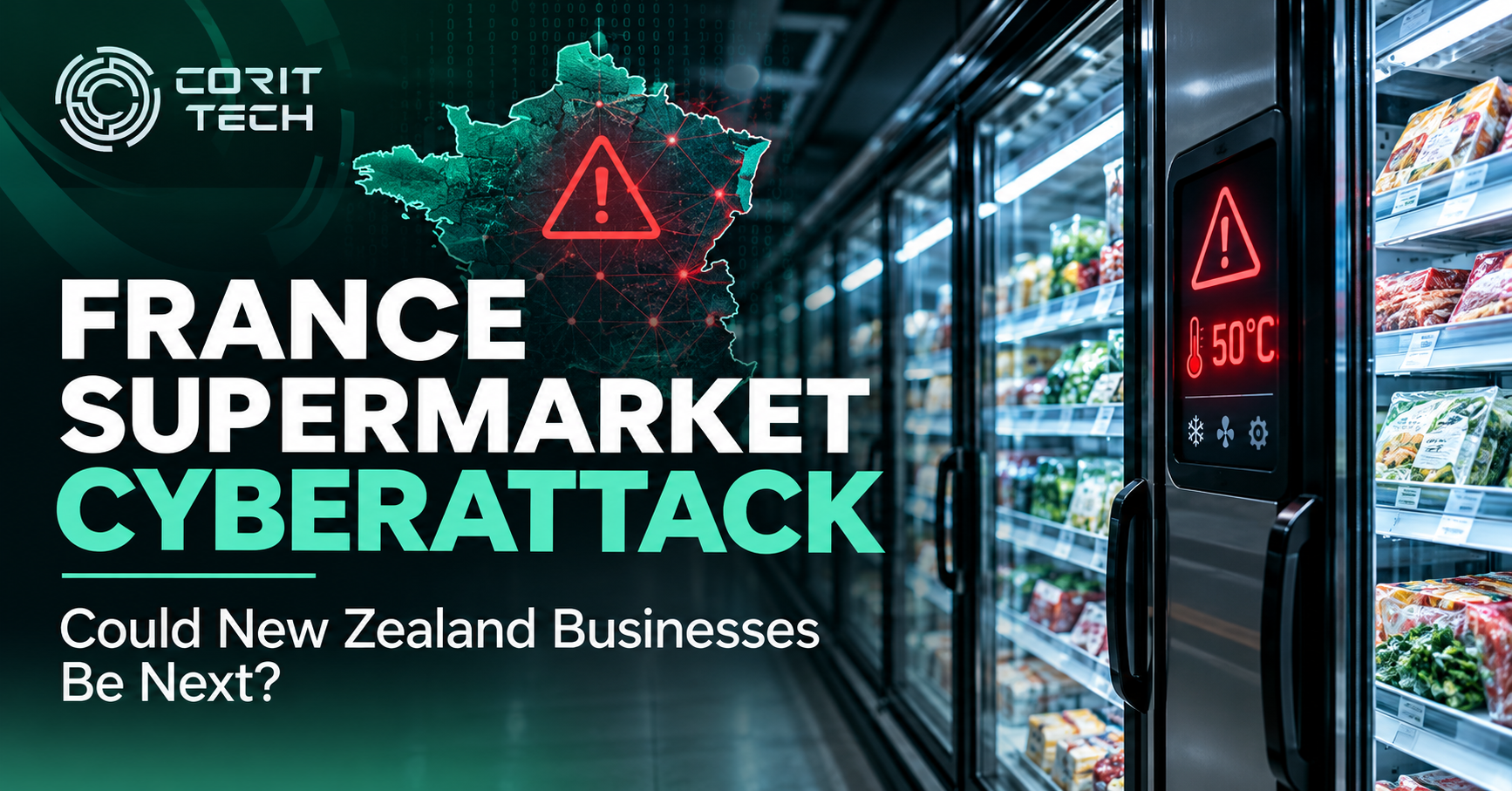
In October 2026, hackers compromised refrigeration control systems across hundreds of French supermarkets, remotely manipulating temperatures and causing significant food losses.
The incident affected major retailers including Carrefour, Intermarché, Monoprix and Coopérative U. Some stores were forced to dispose of large quantities of refrigerated and frozen products.
For New Zealand businesses, this is more than an overseas cybersecurity headline. It is a warning about the risks associated with connected equipment, ageing technology and insufficient security oversight.
The question is no longer simply whether your company’s computers are protected.
What Happened in the France Supermarket Cyberattack?
Between 11 and 12 October 2026, attackers targeted internet-connected refrigeration systems used by French supermarket chains.
Rather than stealing customer information or encrypting business files, the attackers manipulated refrigeration controls, causing temperatures to rise beyond safe storage levels.
Some reports indicated temperatures reaching approximately 50°C, damaging equipment and spoiling perishable food.
According to Reuters, at least 350 supermarkets were affected. Other reporting indicated a wider impact as investigations continued.
The incident involved refrigeration systems using technology associated with Danfoss, Copeland and Dixell.
Many affected systems reportedly used outdated firmware or equipment that had reached the end of its supported life.
Cybersecurity researchers had previously identified vulnerabilities in certain refrigeration controllers, raising questions about whether known weaknesses had been adequately addressed.
As of 14 October, investigators had not publicly established the attackers’ identities or confirmed the precise method of compromise. No group had publicly claimed responsibility.
The incident demonstrates an important cybersecurity reality: attackers do not necessarily need sophisticated ransomware to cause serious business disruption.
Sometimes, compromising an inadequately secured operational system is enough.
Could a Similar Cyberattack Happen in New Zealand?
Yes. A similar attack is technically possible wherever vulnerable operational equipment is accessible through inadequately secured networks or remote connections.
This does not mean New Zealand supermarkets are currently experiencing the same attack, nor does it establish that the specific vulnerabilities exploited in France are present in New Zealand.
However, the underlying security risks are not geographically limited.
Many New Zealand businesses rely on connected technology to monitor, automate and manage essential operations.
Examples include:
- Supermarkets and grocery retailers: Refrigeration systems, inventory management, point-of-sale terminals and electronic monitoring.
- Food manufacturers and distributors: Cold-storage facilities, temperature sensors, production equipment and warehouse automation.
- Hospitality businesses: Commercial refrigeration, ordering platforms, building controls and payment systems.
- Healthcare providers: Connected medical equipment, temperature-controlled pharmaceutical storage and building management systems.
- Manufacturing and logistics companies: Industrial controllers, remote monitoring systems, automated machinery and connected warehouse infrastructure.
These technologies improve efficiency, but they can also introduce additional points of exposure.
When equipment is connected to a network, its cybersecurity becomes part of the organisation’s broader operational risk.
Why Connected Equipment Can Become a Cybersecurity Weakness
Modern businesses increasingly rely on the Internet of Things (IoT) and operational technology (OT).
IoT refers to physical devices that collect or exchange information through networks. Operational technology includes systems that monitor or control physical processes, machinery and infrastructure.
Unlike conventional office computers, these systems may operate for many years without substantial upgrades.
Several common weaknesses can increase their exposure.
1. Outdated Software and Unsupported Equipment
Some industrial and commercial systems remain in service long after their manufacturers stop providing security updates.
Even when vulnerabilities become publicly known, businesses may be unable or slow to apply patches.
Unsupported equipment can create persistent security gaps, especially when connected to the internet.
2. Unsecured Remote Access
Businesses often allow technicians, equipment suppliers and maintenance providers to access systems remotely.
Without appropriate access controls, monitoring and secure connections, remote management tools can become potential entry points for attackers.
3. Limited Network Segmentation
When operational equipment shares a network with ordinary business systems, a compromise in one area may create opportunities to access another.
Separating critical operational systems from less trusted networks helps limit the potential impact of a security incident.
4. Third-Party Technology Dependencies
A business may have strong internal cybersecurity practices while still depending on equipment, software or remote maintenance services supplied by another organisation.
This creates additional risks that need to be assessed and managed throughout the supplier relationship.
5. Insufficient Monitoring
Some connected systems are designed primarily for operational reliability rather than cybersecurity visibility.
Without appropriate security logging, alerts and anomaly detection, suspicious activity may remain unnoticed until equipment stops functioning or business operations are disrupted.
What Does New Zealand’s Cybersecurity Landscape Tell Us?
New Zealand is not immune to cyber threats affecting businesses overseas.
The National Cyber Security Centre’s 2026 Cyber Threat Report highlights ongoing risks from cybercriminals, compromised supply chains, vulnerable systems and increasingly sophisticated attack techniques.
The report also identifies an 18% increase in criminal or financially motivated incidents among reported incidents classified as potentially nationally significant during the previous reporting period.
For New Zealand business leaders, the implications extend beyond protecting confidential information.
Cybersecurity is also about maintaining operational continuity.
An incident affecting refrigeration, manufacturing systems, inventory platforms or essential business applications can result in:
- Lost or damaged stock
- Interrupted business operations
- Unexpected equipment repair and recovery costs
- Disruption to customers and suppliers
- Potential safety and regulatory concerns
- Reputational damage and loss of customer confidence
For businesses with temperature-sensitive products or time-critical services, even a relatively short disruption can have serious consequences.
The French supermarket incident demonstrates why cybersecurity should be considered alongside business continuity, operational resilience and risk management.
Could Your Business Be the Next Cyberattack Target?
The cyberattack on French supermarkets is a reminder that even everyday business systems can be vulnerable. Don’t wait for disruption to discover gaps in your IT security. Get a clearer picture of your technology risks with our FREE CorIT Technology 360° Assessment.
Six Cybersecurity Measures New Zealand Businesses Should Prioritise
1. Identify Every Connected Device
Businesses cannot adequately protect equipment they do not know exists.
Conduct an inventory of connected devices, including refrigeration controllers, monitoring systems, smart building equipment, network hardware and third-party remote access tools.
Document each device’s purpose, software version, support status and network connectivity.
2. Review Firmware and Software Updates
Check whether equipment manufacturers have issued security advisories or updates.
Prioritise known vulnerabilities affecting internet-accessible devices and business-critical infrastructure.
Where equipment is no longer supported, develop a replacement plan or introduce appropriate compensating security controls.
3. Secure Remote Access
Review who can remotely access business systems and whether that access is necessary.
Use secure remote access solutions, strong authentication and restricted permissions.
Where supported, implement multifactor authentication and remove unnecessary internet-facing management interfaces.
4. Separate Critical Operational Systems
Implement appropriate network segmentation between operational equipment, staff devices, guest Wi-Fi and other business applications.
Restrict communication between systems to what is operationally necessary.
This can reduce the likelihood that a compromise spreads across multiple business functions.
5. Monitor for Unusual Activity
Establish appropriate monitoring for critical systems, including unexpected configuration changes, unfamiliar remote connections and abnormal equipment behaviour.
For temperature-controlled operations, independent monitoring and alerts can provide an additional safeguard against equipment malfunction or malicious manipulation.
6. Prepare for Operational Disruption
A cybersecurity incident response plan should address more than lost files or unavailable computers.
Consider how the business would respond if essential equipment became inaccessible, malfunctioned or began operating outside safe parameters.
Document escalation procedures, equipment isolation options, supplier contacts, manual operating procedures and recovery priorities.
Test these arrangements regularly.
Cybersecurity Is No Longer Just an IT Department Responsibility
One of the most important lessons from France is that cybersecurity vulnerabilities can directly affect physical operations.
A compromised refrigeration controller can damage inventory. A disrupted manufacturing system can interrupt production. A compromised building management platform can affect essential facilities.
For business owners, CEOs and operations managers, these are operational and financial risks—not merely technical problems.
This is why cybersecurity needs to be integrated into broader business planning.
Regular security assessments, technology lifecycle management, supplier reviews and incident response planning can help organisations identify weaknesses before they lead to costly disruption.
How CorIT Tech Helps New Zealand Businesses Strengthen Cyber Resilience
At CorIT Tech, we believe effective cybersecurity begins with understanding how technology supports your business and where vulnerabilities may exist.
Our approach goes beyond conventional IT troubleshooting to help businesses assess their technology environments, identify potential risks and make informed decisions about security improvements.
Through our CorIT Technology 360° Assessment, we help organisations review their IT environment and identify opportunities to strengthen security, improve technology management and support business continuity.
Depending on the environment and assessment scope, this can include reviewing network security, device management, access controls, software lifecycle risks and business continuity arrangements.
For organisations relying on specialised operational technology, we can also help identify where additional equipment-vendor or specialist OT security assessments may be necessary.
The French supermarket cyberattack is a reminder that connected technology requires ongoing attention.
Your business may not be a supermarket, but if it relies on connected systems, cybersecurity should be part of your operational risk strategy.
Is Your Business Technology as Secure as You Think?
The cyberattack in France demonstrates how an overlooked technology vulnerability can turn into a significant operational disruption.
New Zealand businesses have an opportunity to review their systems, understand their exposure and strengthen their defences before an incident occurs.
Take the next step with CorIT Tech.
Discover potential vulnerabilities, review your current IT environment and identify practical opportunities to improve your cybersecurity posture.
Book your FREE CorIT Technology 360° Assessment today.
Visit www.corit.tech to get started.
Sources and Further Reading
- Reuters, 13 October 2026 — Investigators hunt French supermarket fridge hackers, no claim of responsibility.
- AFP, 12–13 October 2026 — French supermarkets suffer refrigerator shutdown after unprecedented cyberattack.
- New Zealand National Cyber Security Centre — Cyber Threat Report 2026.
- New Zealand NCSC / Own Your Online — Strengthening Your Supply Chain Security, August 2026.